

The Innovation Department within OIT aims to support the University's pursuit of cutting-edge technologies and innovative solutions. Our mission is to identify strategic problems within the university and propose creative solutions that enhance the overall experience for students, faculty, and staff.
Our dedicated team is constantly exploring the latest trends and technological advancements within the industry and the realm of higher education. We manage the intake of new ideas, prioritize them based on strategic alignment and potential impact, and examine the necessary resources to bring these ideas to life.
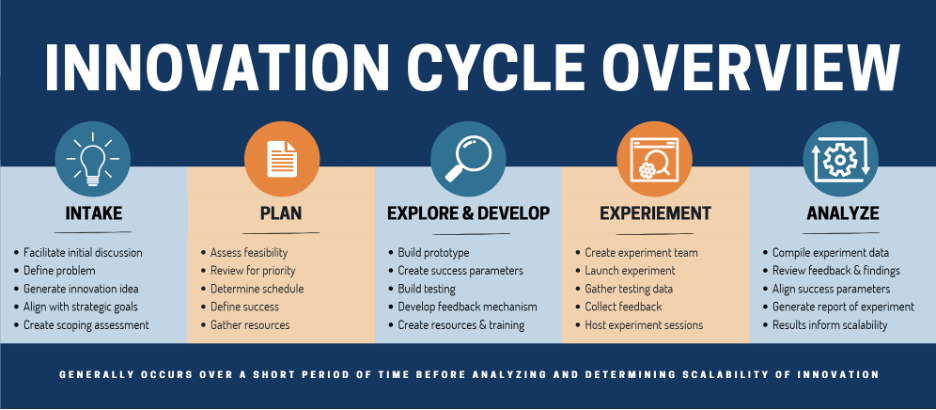
Our structured framework ensures the smooth execution of innovation experiments:
The innovation cycle and activities generally occur over a short period of time. During the exploration and development ideas and moving through experimentation, innovations may be adapted as feedback is collected.
Once a final analysis is conducted, the experiment is closed, and a decision to scale the effort or technology is performed.
The innovation cycle is outlined below, noting activities that may occur within each phase. Click to enlarge the image.
We focus on both short-term and long-term goals to ensure continuous improvement and impactful results.
Short-Term Priorities:
Long-Term Priorities:
Ambient Listening
The Ambient Listening experiment aimed to enhance the student advising process by automatically transcribing and summarizing advising sessions. Leveraging Teams Premium, it reduced the need for manual note-taking and helped improve the quality of advising notes for both staff and students.
Travel Agent
The Travel Agent experiment focused on improving efficiency by automatically handling travel-related policy questions. It used AI to answer the majority of routine inquiries instantly, around the clock, thereby reducing email traffic and allowing staff to concentrate on more complex tasks.
IRB Search Agent
The IRB Search Agent experiment is designed to interpret and respond to inquires about IRB protocols and procedures, reducing staff dependency and expediting decision-making. The experiment aims to evaluate how AI can enhance access to critical compliance information and support researchers throughout the IRB submission process while providing timely access to regulatory and research data, improving operational efficiency and supporting compliance.
AI Teaching Assistant
The Teaching Assistant experiment is an exploration of how generative AI powered by CouldForce NebulaOne that can assist professors by answering student questions related to their course content.
It is designed to be configured with specific syllabi, lecture materials, and assignments to generate context-aware responses. The experiment aims to evaluate the effectiveness of AI in supporting instructional tasks and improving student engagement.
Campus Wide AI
The upcoming campus wide AI or MavAssist Agent experiment aims to provide 24/7 tailored support and resources for faculty and staff. It will utilize university-specific materials, safeguard institutional data, and enhance operational efficiency by making AI assistance widely available across the campus.
The team also includes:
Join us on our journey to transform the university experience through innovation and creativity!

© 2026 The University of Texas at Arlington. All rights reserved.
701 S. Nedderman Drive • Arlington, TX 76019 • 817-272-2011